Write and navigate
Notes are already present in memory. Typing and switching notes give immediate local feedback instead of waiting on disk, IPC, or a network response.
 Skriuw
Private by default, explicit by design
Open Skriuw and write. No account gate, no cloud round-trip, no telemetry. The workspace is local first; every network feature waits for your decision.
What local means
Desktop workspaces live in SQLite on disk. Browser workspaces use the same Rust core compiled to WebAssembly and store SQLite through the browser's private filesystem.
Notes are already present in memory. Typing and switching notes give immediate local feedback instead of waiting on disk, IPC, or a network response.
SQLite is the canonical workspace. Images are content-addressed local files rather than remote placeholders or inflated document data.
Verified backups, trash recovery, portable workspace archives, and background Git history give mistakes more than one way back.
Export a note or the whole workspace as Markdown. Links, images, and readable source remain useful outside Skriuw.
The boundary
Skriuw has network features. It does not disguise them as local features. Sync, remote AI, and update checks each have a visible boundary.
The sync server can read content stored through sync because end-to-end encryption is not implemented yet. If that boundary does not fit your work, keep sync off; the local application remains fully usable.
Durability
Notes
Plain Markdown outSingle notes and whole workspaces export to files you can open elsewhere.
Workspace
Versioned archivesPortable archives carry structured workspace state and remain compatibility-tested.
History
Git off the writing pathBackground versions protect the archive without slowing the editor.
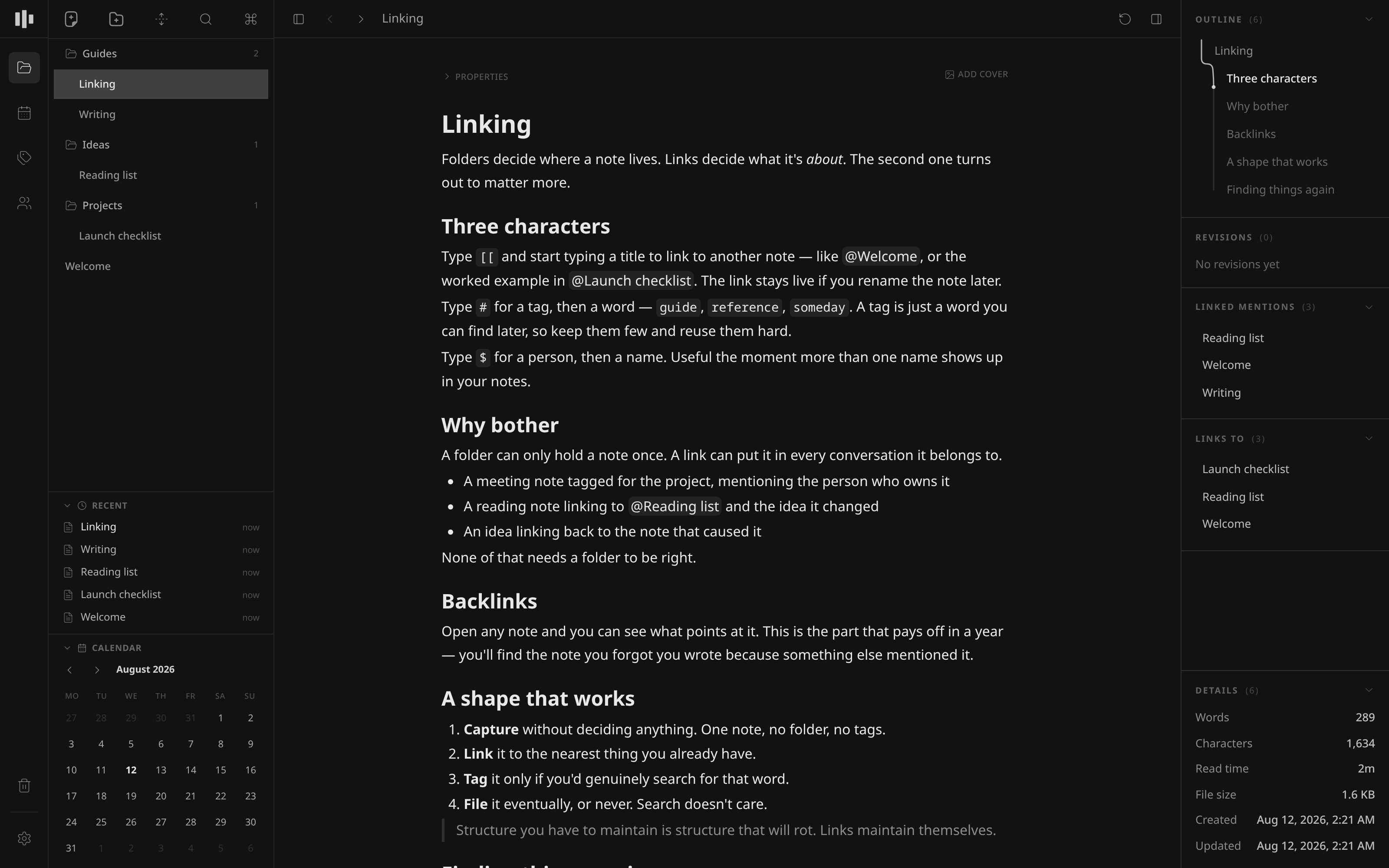
The browser app and desktop app both work without an account.